For decades, cycle tracking was simple: mark the day your period starts, count the days until the next one, and hope the math holds. Early apps digitized this process but didn't fundamentally improve it. They were glorified calendars with a pink color scheme.
That's changing. Artificial intelligence is transforming how we track, understand, and predict menstrual cycles — and the implications go far beyond knowing when to carry tampons.
The Evolution of Cycle Tracking Technology
Generation 1: Calendar Math (1990s–2010s)
The earliest digital cycle trackers used the calendar method: take your average cycle length, count forward from your last period, and predict the next one. This is the same approach people used with paper calendars for centuries.
The problem: menstrual cycles are not metronomes. The average cycle is 28 days, but "average" hides enormous variation. A study published in npj Digital Medicine (2019) analyzing over 600,000 cycles found that only 13% of women have a consistent 28-day cycle. Real cycles range from 21 to 35 days and vary month to month.
Calendar-based prediction accuracy: approximately 20–25% for pinpointing ovulation day.
Generation 2: Statistical Models (2010s–2020s)
The next wave of apps applied basic statistics. Instead of assuming a fixed cycle length, they calculated running averages, weighted recent cycles more heavily, and used standard deviation to estimate prediction windows.
Apps like Clue and Flo popularized this approach. It was better than calendar math but still fundamentally limited: these models treat every person's cycle as a series of numbers, ignoring the biological signals that actually drive cycle timing.
Statistical model prediction accuracy: approximately 30–40% for ovulation day.
Generation 3: Biomarker Integration (2018–present)
Natural Cycles pioneered the integration of basal body temperature (BBT) measurements into prediction algorithms. By measuring a biological signal — the post-ovulation temperature rise caused by progesterone — the app could confirm that ovulation had occurred, rather than just predicting it statistically.
Other apps incorporated LH test results, cervical mucus observations, and data from wearable devices (Oura Ring, Apple Watch, WHOOP). Each additional data stream improved accuracy.
Biomarker-enhanced prediction accuracy: approximately 70–80% for ovulation day with consistent BBT tracking.
Generation 4: AI and Machine Learning (2023–present)
The current frontier uses artificial intelligence — specifically machine learning and large language models — to process multiple data streams simultaneously, identify patterns humans miss, and adapt to individual biology over time.
This isn't marketing hype. A 2025 study in Fertility and Sterility found that machine learning models trained on cycle data, symptoms, and wearable inputs could predict ovulation timing with 89% accuracy within a 2-day window — significantly outperforming statistical models.
How AI Actually Works in Cycle Tracking
Pattern Recognition Across Data Streams
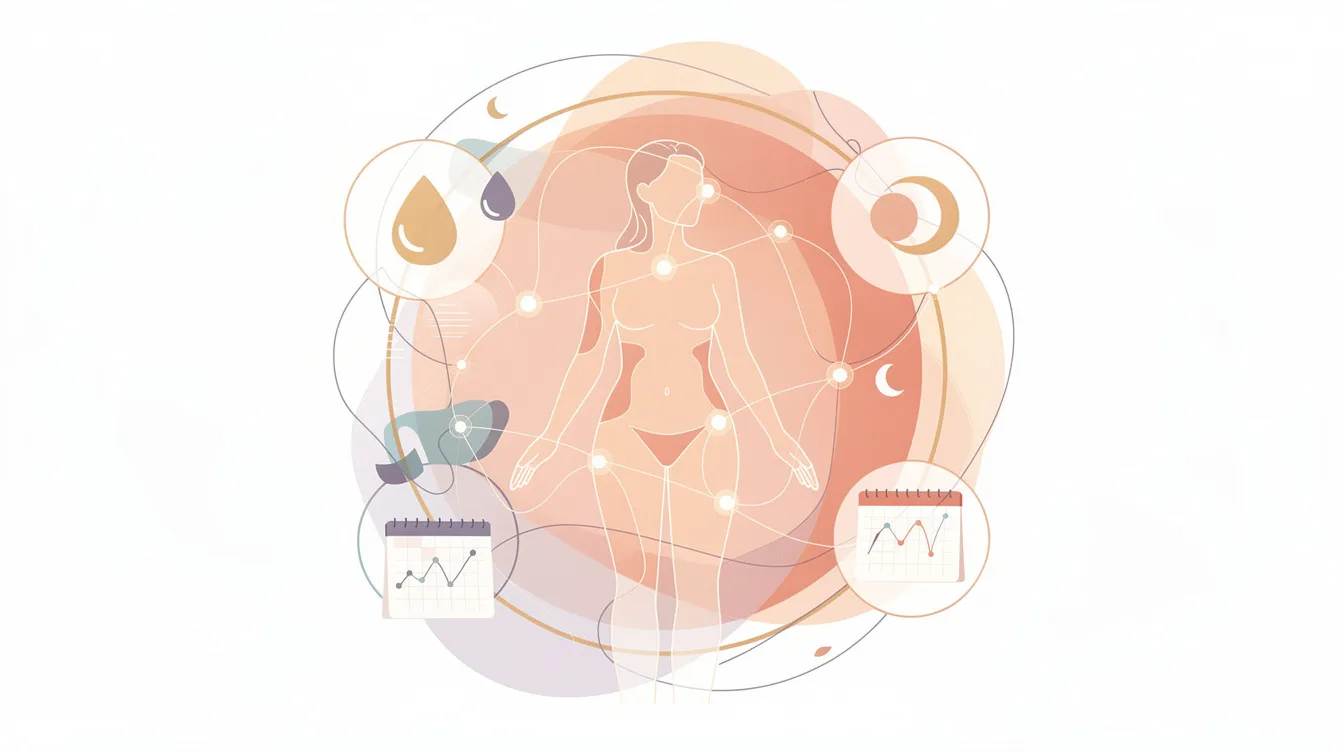
Traditional apps analyze each data point independently: period dates go into one algorithm, symptoms into another. AI models can analyze everything together — sleep patterns, mood changes, physical symptoms, exercise habits, stress levels, BBT trends — and find correlations that simpler models miss.
For example, an AI model might learn that for a specific user, a particular combination of mood change + sleep disruption + slight temperature dip reliably predicts ovulation 2 days later. No rule-based system would find this pattern; it's unique to that individual.
Natural Language Processing for Symptom Logging
One of the most practical AI applications in cycle tracking is natural language processing (NLP). Instead of tapping through menus of predefined symptoms, users can describe how they feel in their own words.
"I've been feeling bloated since yesterday, had a headache this morning, and my mood has been all over the place" — an NLP-powered system can extract structured data from this sentence: bloating (duration: 2 days), headache (timing: morning), mood swings (severity: moderate).
This dramatically reduces friction in daily logging. Research consistently shows that the biggest challenge in cycle tracking isn't the technology — it's getting users to log consistently. By making logging as easy as sending a text message, AI removes the primary barrier to accurate tracking.
Personalized Prediction Models
Perhaps the most important advancement: AI enables truly personalized predictions. Statistical models apply the same formula to everyone, adjusted by a few parameters. Machine learning models can build an individual profile that accounts for:
- Personal cycle variability patterns
- How symptoms correlate with cycle phases for that specific person
- Impact of lifestyle factors (travel, stress, exercise, diet changes)
- Medication effects (hormonal and non-hormonal)
- Seasonal variations
- Long-term trends (gradual cycle changes with age)
The model improves with every logged data point, becoming increasingly accurate over time.
Rule-Based vs. LLM-Powered: What's the Difference?
Rule-Based Systems (Most Current Apps)
Most period trackers, including Flo and Clue, use rule-based systems. These follow predetermined logic:
IF average_cycle_length = 28 AND last_period_start = March 1
THEN next_period_predicted = March 29
AND ovulation_estimated = March 15
Rules can be sophisticated — incorporating weighted averages, seasonal adjustments, and symptom modifiers — but they're fundamentally limited. Every rule must be explicitly programmed by developers. The system cannot discover new patterns or adapt to situations the developers didn't anticipate.
Machine Learning Models
ML models learn patterns from data without explicit programming. Feed them enough cycle data, and they'll discover relationships between variables that no developer would think to code. They adapt to each user's unique patterns and improve over time.
The downside: ML models require substantial data (both historical user data for training and ongoing data for personalization). They're computationally expensive and can be "black boxes" — their predictions are accurate but not always explainable.
Large Language Models (LLMs) in Cycle Tracking
LLMs represent the newest approach. Unlike traditional ML models that work with structured numerical data, LLMs can process natural language — the way people actually describe their health experiences.
This enables capabilities that neither rule-based nor traditional ML systems can match:
- Conversational symptom logging: Describe your day in plain language; the AI extracts and categorizes symptoms
- Contextual understanding: The AI understands that "I couldn't sleep because of cramps" contains information about both sleep quality and pain
- Health education: Ask questions about your cycle in natural language and get personalized, contextual answers
- Multi-signal synthesis: The AI can weigh dozens of data points simultaneously — symptoms, cycle history, lifestyle factors — and provide a coherent interpretation
Privacy Implications of AI in Health Apps
AI in health apps raises legitimate privacy concerns that deserve honest discussion.
The Data Requirement Problem
AI models need data to work. The more data, the better the predictions. This creates a tension with privacy: the most accurate cycle prediction would use all your health data, processed continuously. The most private approach would store nothing and process nothing.
Every AI-powered health app navigates this tradeoff. The critical question is: where is the data processed, who has access, and how long is it retained?
Cloud vs. On-Device Processing
Some AI operations can run on your device (on-device inference). Others — particularly LLM interactions — require cloud processing because the models are too large for mobile devices.
For cloud-processed AI, the key privacy factors are:
- Is data encrypted in transit?
- Is the AI provider contractually prohibited from using your data for training?
- How long is data retained by the AI provider?
- Is processing ephemeral (data discarded immediately after use)?
What to Look for
When evaluating an AI-powered cycle tracker, ask:
- Does the app disclose which AI provider it uses?
- Is health data encrypted before being sent to the AI?
- Does the AI provider have a data retention policy you can verify?
- Can you use the app's core features without the AI component?
- Is there a clear explanation of what data the AI processes?
The Future of AI Cycle Tracking
Wearable Integration
As wearable devices become more sophisticated — continuous temperature monitoring, blood oxygen tracking, HRV analysis — AI models will have richer data streams to work with. The combination of passive wearable data and active symptom logging, processed by AI, will likely push ovulation prediction accuracy above 95%.
Predictive Health Insights
Beyond cycle prediction, AI models may eventually identify early indicators of conditions like PCOS, endometriosis, or thyroid disorders based on cycle pattern anomalies. This is speculative but grounded in research: several studies have shown that cycle irregularities often precede clinical diagnosis of these conditions by months or years.
Personalized Health Recommendations
AI could tailor exercise, nutrition, and lifestyle recommendations to individual cycle patterns — not generic "follicular phase = do HIIT" advice, but personalized suggestions based on how your body responds to different activities in different cycle phases.
The Bottom Line
AI is not a gimmick in cycle tracking. It represents a genuine improvement in prediction accuracy, user experience, and personalized health insights. The gap between a rule-based calendar app and an AI-powered cycle tracker will only widen.
The key is choosing an app that uses AI responsibly: transparent about its methods, protective of your data, and honest about its limitations. AI should make cycle tracking easier and more accurate — not become another vector for data exploitation.
This article was last updated in March 2026. AI capabilities in health apps are evolving rapidly.